


 Lydia Maguire
I’ll admit it. Even as an avid board game lover, Mahjong always intimidated me. I don’t know why. Maybe the tiles, maybe the terminology, maybe the fact that everyone who plays seems to already know exactly what they’re doing. It just felt complicated.
Ready or not, though, Montclair has clearly entered its Mahjong era.
The demand is so high that the Montclair Public Library, which offers Mahjong classes through its adult education program, had to add three additional sessions and still has a waiting list. So, for the sake of this article, and my own curiosity, I went on a mission to figure out how to play, where to play, and who to play with. What I learned is that while Mahjong looks intimidating from the outside, it’s surprisingly social, strategic, and once you get the hang of it, borderline addictive.
Before we dive in, a quick clarification. There are multiple versions of Mahjong. Traditional Chinese Mahjong varies widely by region and ruleset, and every person I asked tried( and failed) to explain it to me succinctly. What most people around Montclair are playing, though, is American Mahjong, which is standardized by the National Mahjong League, or NMJL. That’s the version you’ll encounter at classes, public games, and living room tables around town. Read on to learn everything you need to know about Mahjong in Montclair: how to play Mahjong and where to play Mahjong.
A Brief History of Mahjong + How It Became American
Mahjong originated in China in the late 19th century, evolving from earlier card and betting games. It spread quickly, becoming both a strategic pastime and a deeply social ritual. In the 1920s, Mahjong exploded in popularity in the United States, particularly among Jewish communities. In 1937, the National Mahjong League was founded to standardize rules and create an official American version of the game, complete with jokers, racks, and the annual card that changes the hands each year.
What struck me most while playing wasn’t just the strategy. It was the conversation. While I may have been concentrating intensely, seasoned players were chatting about family, holiday plans, and Montclair school issues in the kind of easy, connective talk that turns a game into a community.
Elisa Hirsch, who teaches Mahjong through the library, said she originally took it up for a reason that made me laugh, and also made total sense. “I was thinking, what could we do that doesn’t involve eating? It’s just not my thing,” she said. “And I came up with Mahjong.”
Read More: Newark’s Prudential Center: What to Know
How to Play American Mahjong Without Getting Overwhelmed
If you’ve ever played Rummy, or better yet, Rummikub, the core idea of Mahjong will feel familiar. The game is typically played with four players, each working toward a winning hand, appropriately called “Mahjong.”
Each year, the National Mahjong League releases an official card that defines all the possible winning hands for that year. Everyone plays from the same card, which keeps the game fair and forces even longtime players to learn new combinations annually.
Cracks, Bams, + Dots, Oh My
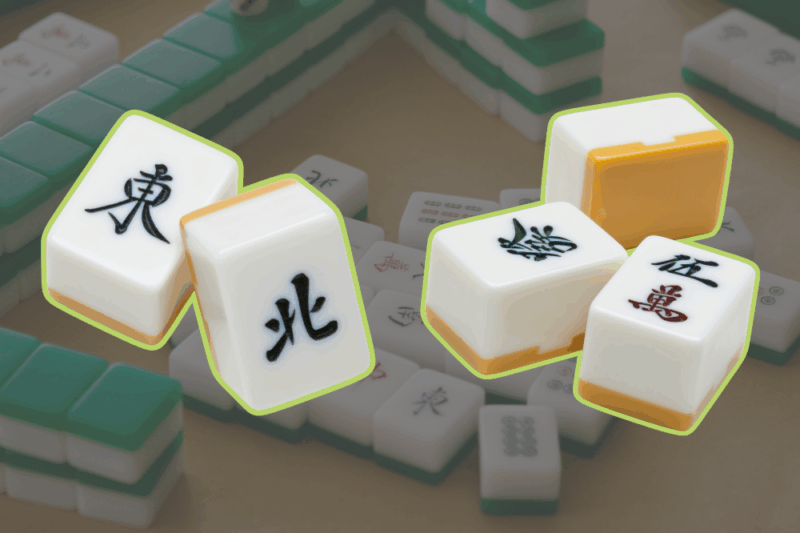
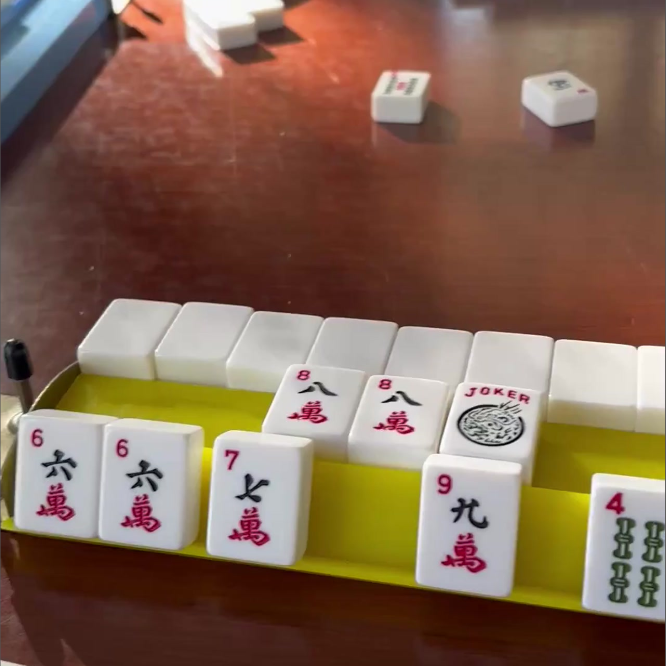
American Mahjong uses three numbered suits from 1 to 9. They are Dots, Bams, which is short for bamboo, and Cracks, which look like Chinese characters. There are also Dragons. The Red Dragon goes with Cracks. The Green Dragon goes with Bams. The White Dragon is called “Soap,” and it can act as a zero or a dragon, depending on the hand. You’ll also see Winds, which are North, South, East, and West, plus Flowers and Jokers. Jokers can substitute for almost anything, with a few key exceptions.
Hands are built from combinations of singles, pairs, pungs, which are groups of three tiles, kongs, which are groups of four tiles, and sometimes quints, which are groups of five tiles. A complete winning hand has 14 tiles.
Setting Up the Game
Each player builds a “wall” of tiles, which is two rows of 19 tiles placed face down in front of them. One player is designated East, also known as the dealer, and starts with 14 tiles. Everyone else begins with 13.
There are versions for three players, including a charmingly named phantom fourth player often called “Hildegard,” and even two-player variations, but if you’re new, the classic four-person setup is the way to go.
To deal, the dealer distributes four tiles at a time, starting with themselves and moving clockwise, until everyone has 12. Then each non-dealer takes one more tile to make 13, and East takes two more tiles to start with 14.
The Charleston, Also Known as Organized Chaos
Once tiles are dealt, the game begins with two rounds of the Charleston, a structured tile passing phase consisting of three passes of three tiles each before regular play.
For the first Charleston, each player selects three tiles they don’t want and passes them right, then across, then left. On the third pass of the Charleston, there is an optional “blind” move if you want to keep what you have and pass along what you receive. Then the process repeats in the opposite direction (the second Charleston). Players pass left, then across, then right, again with an optional blind pass on the final exchange. After the Charleston, players may do a courtesy pass with the person across from them, trading none, one, two, or three tiles.
This is when knowing your NMJL card really matters, because it helps you decide which hands you’re realistically aiming for and which tiles are expendable.
Playing the Game
The game begins with East discarding the first tile. Turns move counterclockwise. On your turn, you draw a tile, unless you’re East on the first turn, then you discard one tile, naming it out loud, like “3 Dot,” “7 Bam,” “Soap,” and so on. Discarded tiles are generally out of play unless another player can call them immediately as part of a pung, kong, or quint. Tiles may only be called from the most recent discard, and jokers can never be called. Once a joker is discarded, it’s gone for good.
If you call a tile, you must lay down the completed grouping immediately, and once tiles are laid down, you’re committed. Be warned. Experienced players will absolutely clock which hand you’re chasing. Some hands on the NMJL card are marked with a C, meaning they are “Closed” hands. These cannot be called tiles at all, making them harder and more valuable.
When a player completes a legal hand, they call “Mahjong!” and the game ends. If the wall runs out with no winner, it’s declared a wall game.
Where to Play Mahjong in Montclair
If you’re wondering where all these Mahjong players are actually gathering, you’re not alone. That’s the number one challenge Elisa is trying to solve.
“This is actually something we’ve been working on through the library, and also I’m looking on my own for spaces,” she told MG. “Because I have over 370 students.”
She said she encourages students to exchange numbers in class so they can form their own groups, but otherwise, “they really can’t find each other.” To help bridge that gap, she recently started a Facebook group under her Fairy Mahjmother brand “just for my students,” she said, because she was trying to create a simple way for people to connect and find a game.
Montclair Public Library
The Montclair Public Library offers Mahjong classes taught by Elisa Hirsch, and demand is sky high. As Elisa put it, “I can’t teach enough classes,” adding that even after opening additional sessions, she still had “35 people on the wait list.”
The library is also working on creating more public play options, including an open, drop-in game. Elisa said that is the part that can catch people by surprise. “I just think they’re not going to understand how many people are going to show up,” she said.
The Montclair Public Library, Bellevue Avenue Branch, also offers two weekly Mahjong programs. The Mah Jongg Self-Paced Learning Space provides an opportunity to learn the basics of Mahjong, and a weekly Thursday morning Mah Jongg Meetup is held for those who want to meet fellow players and practice their skills.
Edgemont Park
Edgemont Park previously hosted a public Mahjong game that filled up quickly. Its current status is unclear, but interested players can contact the park to ask about restarting the group or joining a waitlist.
Temple Ner Tamid
Members of Temple Ner Tamid can join an open Mahjong game, and in the spirit of full transparency, they kindly welcomed this writer so I could learn the game firsthand. I even managed to win Mahjong, though I strongly suspect they went easy on me.
Finding Your Own Group
View this post on Instagram
A lot of Mahjong in this area happens in living rooms, clubhouses, and informal community spaces. Elisa mentioned that some groups meet in places like the YMCA, though membership may be required, and that you can sometimes find games through sites like Meetup. If you already know how to play and you’re simply trying to find a table, Elisa’s best advice was simple. Keep asking, keep connecting, and keep showing up.
At its best, Mahjong is not just a game. It’s a reason to gather.
“This was my way to find community and keep my friends together,” Elisa said. “Book clubs aren’t for everybody.”
Where to Buy a Mahjong Set
One of the great things about Mahjong is that you only need one set for four players. Sets range widely in price, from luxury designer versions that cost thousands to mid-range prices for stylish sets (like this one from Anthropologie or these ones from Oh My Mahjong) to solid beginner sets you can buy online for under $100. If you’re buying a set, make sure it’s American Mahjong and that it includes 166 tiles, four racks with pushers, and ideally a tile bag and a carrying case.
You’ll also need the annual NMJL card, which costs about $14 and is essential for gameplay. Elisa is a “collector,” meaning people can order their NMJL cards through her at the same price, and a portion is donated to a charity she chooses.
“They take a percentage of my total cost, and they donate off the top,” she explained. “My charity is The Seeing Eye, based out of Morristown. Last year we raised over $1,200.”
I loved Mahjong so much that I bought a set for my mom for Christmas so we can play while she’s in town.
Oops.
I guess now she knows.
See More: Hoboken Bars With Theme Nights, Games, + More
Follow @themontclairgirl on Instagram + TikTok for the latest Montclair updates, sign up for our weekly newsletter here that shares everything you missed each week, and check out our events calendar, which has over 100+ events weekly to peruse.